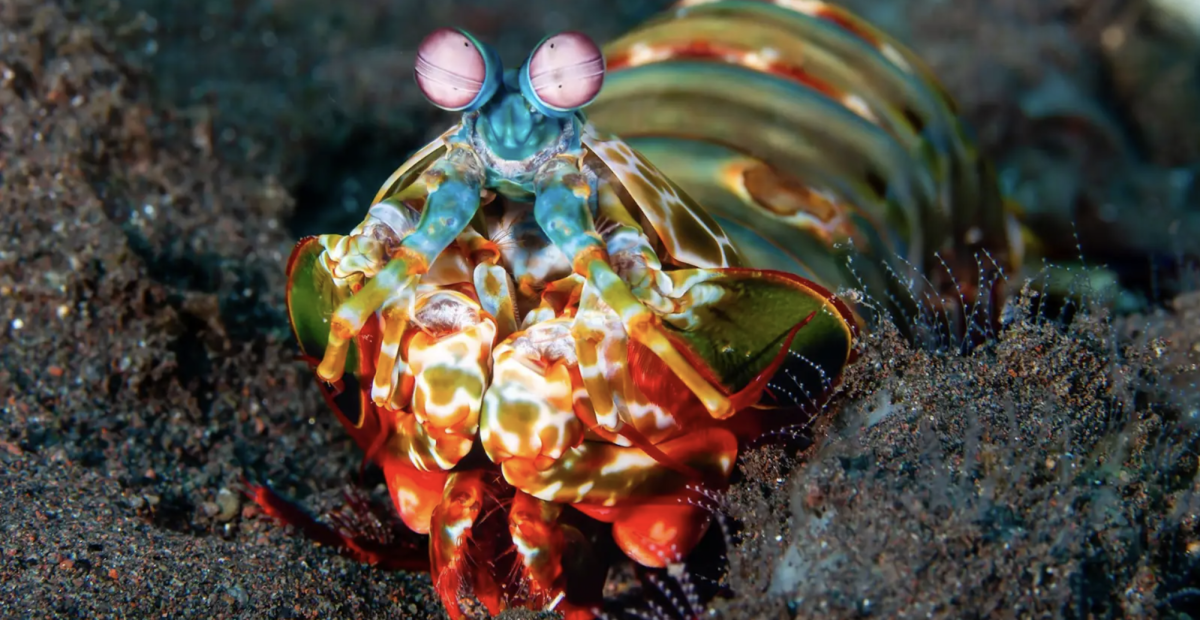
Ever seen those stories about a small underdog who defeated opponents bigger, stronger, and taller than them? From David and Goliath to Rocky’s Rocky Balboa, everyone loves the classic underdog story. Beyond ancient tales and movies, though, one of nature’s most striking examples of an underdog is the tiny Peacock mantis shrimp: capable of striking a punch with the force of a .22 caliber bullet. While it may look to be a timid, rainbow-colored exoskeleton of vibrancy upon first glance, the shrimp is nothing short of the most powerful puncher in the animal kingdom.
For most underwater creatures, a simple flick from an arm does not generate a force comparable to a bullet. However, the Peacock mantis shrimp is biologically unique in that its body has a special mechanism that allows it to exert a massive amount of force within a split second. When its arm is locked and tightly secured, the mantis shrimp generates power by contracting its muscles. Energy is then stored in a saddle-like structure that acts like a spring and, when unlatched, allows the shrimp to deliver a devastating punch of 15,000 Newtons to its target at speeds up to 80km/hr.
But the punch isn’t where the shrimp’s strength ends. Bubbles form from the low pressure of water, the superspeed punch causes. When water pressure normalizes, the bubbles collapse, generating a megahertz-level shockwave due to cavitation. The shockwave scatters at a frequency level higher than the original punch, blasting the shrimp’s target with even more overwhelming force.
Despite its destructive abilities, another wonder is the mantis shrimp’s ability to punch without damaging itself. The clubs of the Peacock Mantis Shrimp have two layers that enable it to sustain its indestructible punch: the impact and periodic region. The Impact region is the outer layer, made of mineralized fibers arranged in a herringbone pattern, which helps the punch resist fractures. The second layer, the periodic region, consists of bundle fibers like a corkscrew, filtering out high-frequency stress waves to stop the force from propagating through the rest of the Peacock Mantis Shrimp’s body.
The unique structure of the mantis shrimp has brought it to various parts of academia. UCI materials scientist David Kisailus has applied the shrimp to his studies of it to designs with the Air Force for mortar-launching systems, armored applications, and ultralightweight cages for drones. Furthermore, Sejin Lee from the NIST (National Institute of Standards and Technology) experimented with an engineered synthetic material inspired by the mantis shrimp’s resilient protection against its punches, aiming to build a less malleable object—showing how the shrimp is being used to expand the limits of technology.
Even though the peacock mantis shrimp’s punch mechanism and structure can only be viewed at an insightful level of scientific research, its minuscule yet ingenious nature has inspired technology to expand its limits.