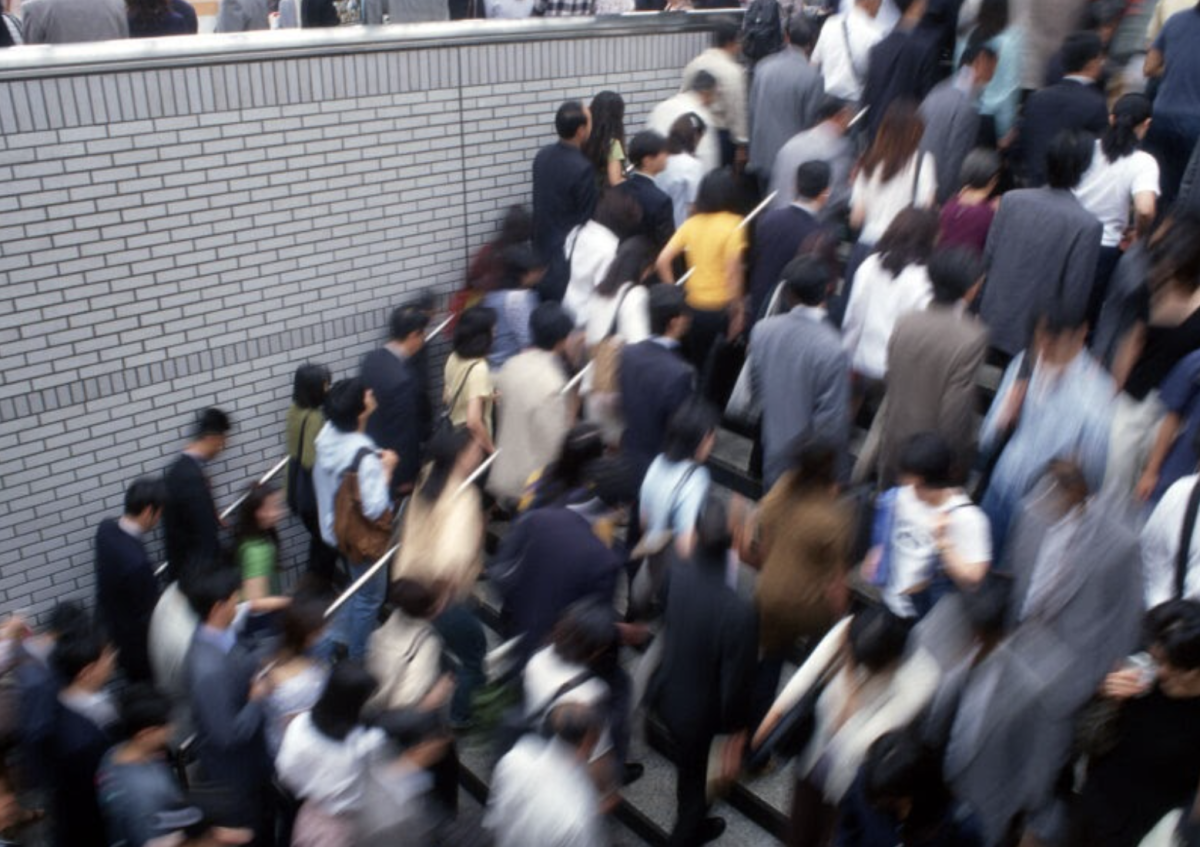
Japan’s work environment has long been notorious for its long work hours, high pressure, and heavy workload. This culture of extreme overwork and mandatory unpaid overtime, coupled with strict hierarchical structures that prioritize company loyalty over personal life, has become deeply ingrained in Japanese society. This pressure to meet unrealistic expectations has taken a severe toll on workers’ mental and physical health, leading to tragic outcomes such as “Karoshi,” which directly translates to “death by overwork.”
“Karoshi” is a Japanese sociomedical term used to describe sudden work-related death. Common causes of karoshi deaths are cardiovascular attacks, specifically strokes and heart attacks, and suicide due to mental health disorders, overwork, or long-period stressful working conditions, which has its own specific term, “Karojisatsu”.
The first-ever Karoshi case was reported in 1969. Almost a decade later, the term “Karoshi” was recognized as a description of the phenomenon. In 1982, the release of the book “Karoshi,” written by doctors Tajiri Seiichiro, Hosokawa, and Uehata, brought public attention to the issue, but it was not considered a major social problem until the late 1980s during Japan’s Bubble Economy—an era when workers were expected to prioritize their jobs over their lives. Karojisatsu—which refers to suicide resulting from severe mental strain caused by overwork—also became a prominent issue during the Bubble.
One recent case of Karoshi brought the issue back into the national spotlight when Matsuri Takahashi died by suicide after jumping off her company’s dormitory. Takahashi was an employee at Dentsu Inc., Japan’s largest advertising agency, infamous for their strict working environment.
Before her death, Takahashi had posted a series of tweets reflecting her desperate mental state. One of them read, “It’s 4 a.m. My body’s trembling. I’m going to die. I’m so tired.”
To understand how Takahashi’s case is not an isolated tragedy, it is important to examine other typical cases of karoshi. The International Labor Organization highlights cases such as:
- Mr. A, who worked at a major snack food processing company for as long as 110 hours a week (not a month), died from a heart attack at the age of 34. His death was approved as work-related by the Labor Standards Office.
- Mr. B, a bus driver, whose death was also approved as work-related, worked more than 3,000 hours a year. He did not have a day off in the 15 days before he had a stroke at the age of 37.
Recent statistics further supplement the idea that karoshi and overwork-related disorders remain a serious problem today. According to data from Japan’s Ministry of Health, Labor, and Welfare, there were 1,304 officially recognized cases of overwork-related deaths and health disorders in fiscal 2024, an increase of 196 from the previous year. Of these cases, 247 were related to strokes or other heart conditions, while 1,057 involved depression or other mental health disorders. This marks the first time that more than 1,000 work-related mental health cases have been acknowledged. Among them, 89 cases involved suicide or attempted suicide. However, many additional cases are believed to remain unreported or not formally recognized as work-related.
Certain industries are particularly vulnerable to karoshi. Sectors such as transportation and postal services, accommodation and food services, and education and learning support report some of the highest numbers of overwork-related problems, as employees in these fields often work 60 hours or more per week. Reported by the Business and Human Rights Center, one victim, Jun Iijima, an employee of Japan Post Co., Ltd., reportedly worked under extreme heat exceeding 35°C and had confided before his death that he “didn’t even have time to eat a rice ball.” Company records later showed that he was allowed only 15 minutes of break time and, on multiple days, had no breaks at all.
In response to public concern, Japan introduced regulations in 2018 to limit excessive overtime. However, according to the Japan Times, since Sanae Takaichi took office this year, she has instructed the government to consider relaxing overtime regulations. The current maximum is 720 hours per year, but she intends to raise it to support economic growth.
In an interview with DW News, Health Minister Takamaro Fukuoka expressed heavy concern, stating that the ministry ”believes that losing one’s life or health due to overwork must not happen.” At present, it is still unclear how labor laws might change and whether any reforms will truly protect workers.
Karoshi and Karojisatsu are consequences of a deeper structural problem in Japan’s work culture. Changing this issue will require more than minor reforms and legal adjustments; it will require a shift in how Japanese society values productivity over profit. As Matsuri Takahashi’s mother says in a recent interview, “I understand that it takes courage for people to leave where they are, but I want them to protect their bodies and minds more than anything else.”