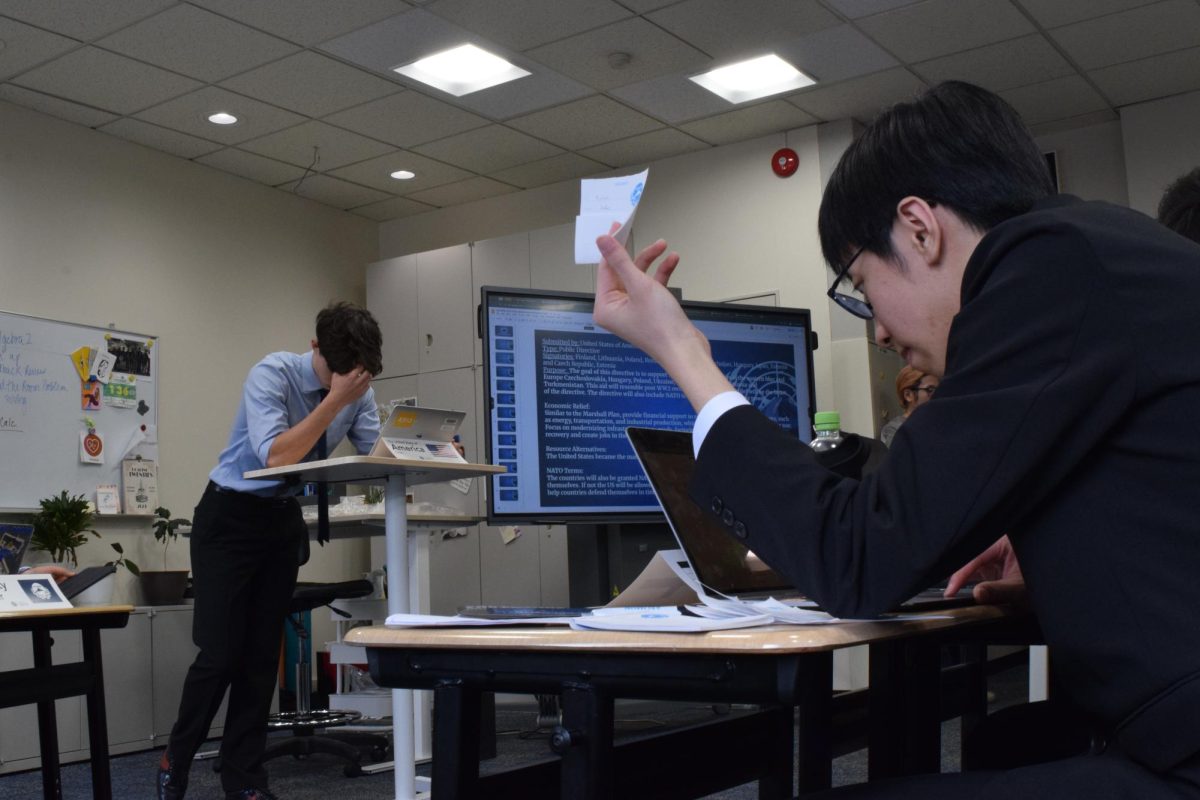
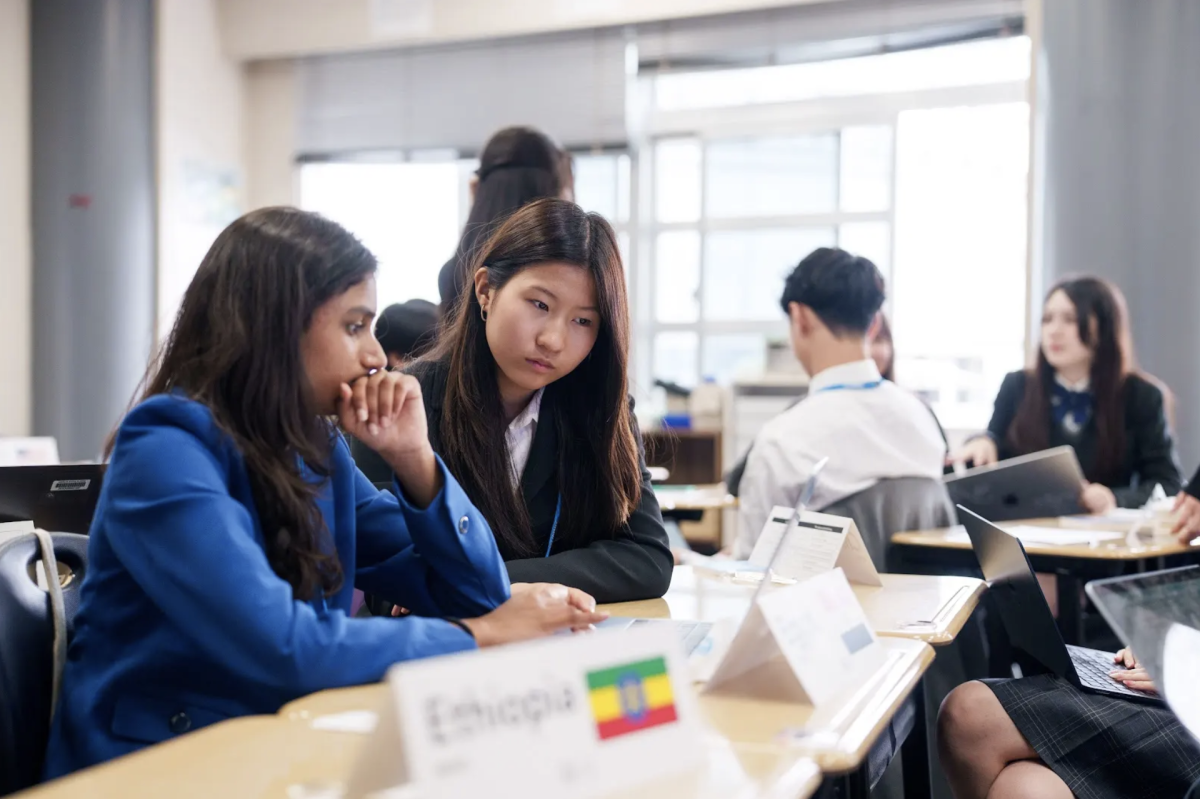
Who gets to be in a clinical trial? Who owns your health data? And should a 13-year-old have access to an infinite scroll feed on Instagram? These were among the questions debated at the World Health Organization (WHO) committee during ASIJ’s sixth annual MUN conference, where students assuming the role of United Nations delegates represented countries from Ethiopia to Switzerland.
MUN simulations begin with opening speeches from each delegate, followed by a structured debate in which countries form blocs and outline resolutions on the given topics. Once resolutions are finalized, delegates can present amendments to the committee before ultimately voting on the resolution as a whole.
This year’s conference theme, “Rewiring Peace in an Age of Diplomacy,” centered on adapting peacebuilding to a world where technology develops faster than policy can respond. In the WHO committee, delegates confronted issues of medical equity, digital safety, and AI in healthcare — challenges that even the most experienced policymakers have yet to fully resolve. As a result, ASIJMUN pushed delegates to craft realistic solutions while carefully balancing their assigned country’s interests.
Medical Research Equity: Who Gets Left Behind?
I observed resolution 1B for the topic “Addressing Justice, Equity, Diversity, and Inclusion in Medical Research”, submitted by the delegates of Ethiopia, Nigeria, Switzerland, the Philippines, and Bangladesh. Although medical research might seem like a more neutral topic, this resolution highlighted the severe inequality that stems from the pharmaceutical research landscape, where drugs and treatment are designed without the world’s most vulnerable communities in mind.
Resolution 1B proposed that 20% of global medical research funding be directed directly to institutions in lower- and middle-income countries, advocated broader dissemination of medical research conducted by higher-income countries to lower-income countries, and called for the creation of online medical research exchange programs between higher- and lower-income countries. It also accounted for the long-term sustainability of this target by including tax reductions for higher-income countries, preemptively offering flexibility in anticipation of realist criticism.
Still, the room remained unconvinced. The United Kingdom, for example, questioned who would monitor compliance and how these targets would be enforced. South Africa also argued that the 20% figure was arbitrary and that the resolution offered no tangible methods of accountability. Switzerland pushed back, claiming that the periodic reporting mechanisms included in the resolution would provide sufficient accountability.
Even the resolution’s own co-submitters were not fully satisfied either: Ethiopia was skeptical of the remote-exchange option, stating that on-the-ground experience would be necessary to understand local healthcare conditions and implement meaningful solutions.
Bangladesh recommended adding a “Care Program” to the resolution, under which communities participating in clinical trials would continue receiving treatment even after the trial’s completion. The committee was generally in agreement that local populations should not be treated merely as sources of data, only to be forgotten once a study ends.
Overall, this year’s ASIJMUN WHO debate highlighted that although everyone can identify global medical inequity as a significant problem, the hardest part is crafting diplomatic solutions that everyone can agree upon. In doing so, delegates shed light on an important truth about global health policy: progress depends not only on recognizing injustice, but also on negotiating the practical, granular details that determine whether reform can move forward.