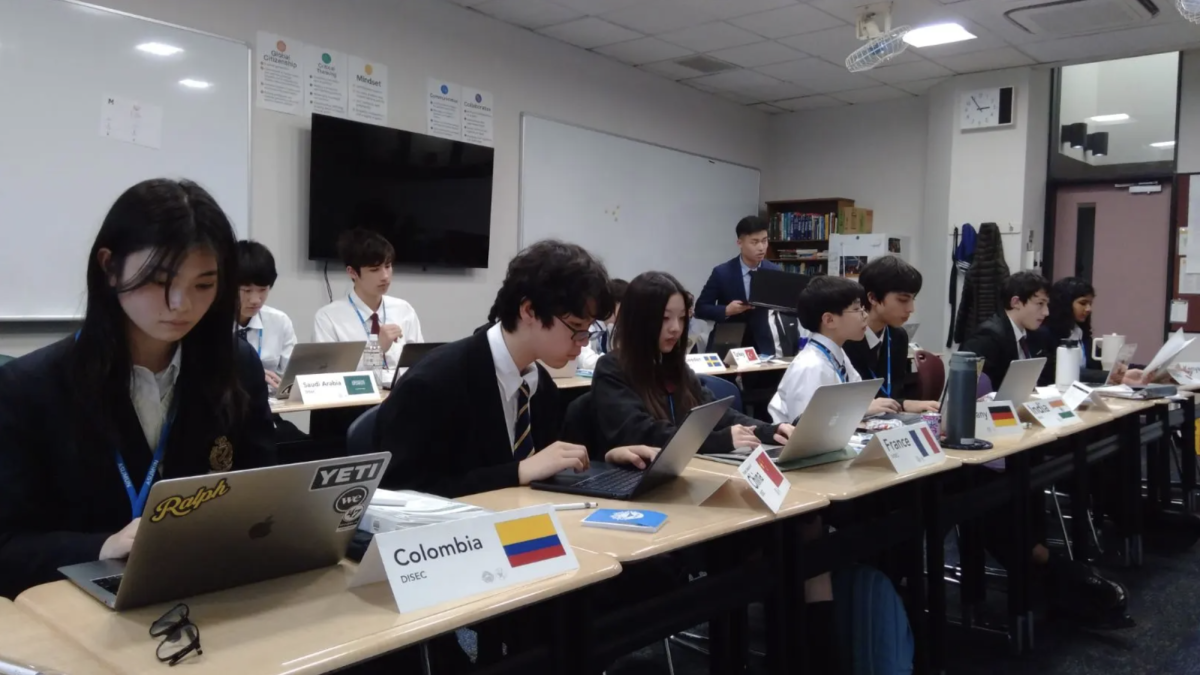
The first day of the Model United Nations conference began under the gaze of the cherry blossoms, as delegates constructively debated solutions to the issues facing the modern world. This article will address developments in two committees: the Special Political and Decolonization Committee (SPECPOL) and the Disarmament and International Security Committee (DISEC).
According to the UN, SPECPOL is the fourth committee of the UN General Assembly, and addresses issues such as decolonization, atomic radiation, and peacekeeping operations. DISEC, the UN states, is the first committee of the UN General Assembly, and addresses issues such as disarmament and international security.
In my time observing the committee, SPECPOL debated its first resolution, submitted by Japan with Spain, France, and the USA co-submitting.
Japan delivered a speech in support of its bloc’s resolution, outlining four key measures to address the militarisation of outer space and the issue of space debris. The resolution called for prohibiting testing of antisatellite technology, establishing a crisis committee for outer space security, creating a mechanism to ensure transparency for space missions, and holding nations accountable for space debris they create.
China expressed concerns about the enforcement of such measures, suggesting the resolution lacks “concrete punishments for the use of antisatellite technology.” Mexico questioned the need for a new crisis committee, given the existence of the Committee on the Peaceful Uses of Outer Space.
Spain and France expressed support for the resolution through speeches emphasizing the importance of a crisis committee that can act rapidly in the event of rising tensions, as well as transparency and confidence-building mechanisms.
Bahrain encouraged the committee to consider amendments to the resolution to strengthen policies and enforcement measures, and to add clauses to ensure that national security and transparency can be balanced.
Haiti proposed an amendment to the resolution encouraging member states to address gaps in current international space laws to prevent the weaponization of outer space, which passed 7-4.
DISEC evaluated various amendments to the first resolution. Submitted by Germany and co-submitted by Türkiye, Saudi Arabia, Sweden, France, India, Ukraine, Nigeria, and the USA, the first resolution tackled the regulation of the development and use of Lethal Autonomous Weapons Systems (LAWS). It addresses the regulation of LAWs, ensuring human operators are kept in the system for control and accountability, transparency through annual reports, and protection of civilians.
Iran, Russia, and the USA also proposed amendments to the resolution, but the amendments were all rejected by majority vote.