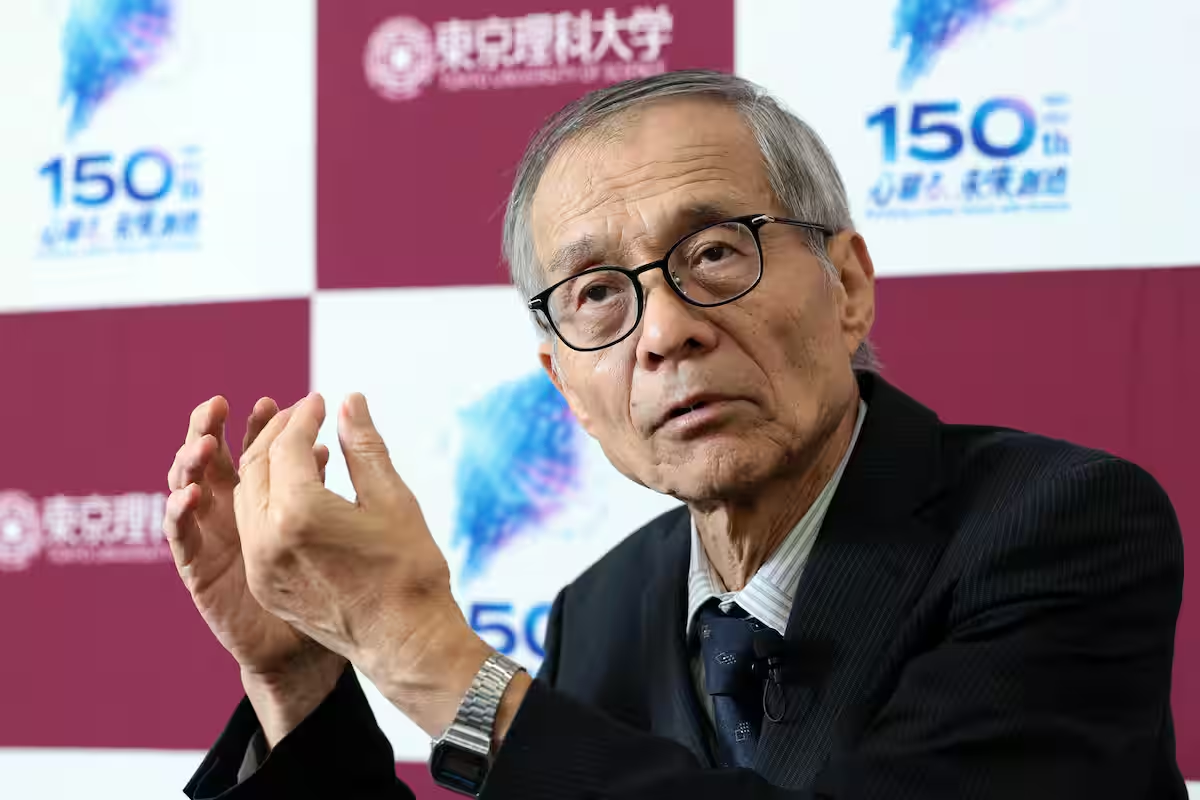
On October 7th, Japanese scientist Kenso Soai, professor emeritus at Tokyo University of Science, won the 2026 Nobel Prize in Chemistry alongside French chemist Henri B. Kagan. They were honored for discoveries regarding non-linear effects and autocatalysis in asymmetric organic synthesis. Their discoveries help scientists understand why certain molecules exist in two different forms, similar to our left and right hands. Although these molecules have the same chemical formula, their shapes are mirror images that cannot perfectly overlap. This property is called chirality.
Chirality is especially important in the medical field because two mirror-image versions of a molecule can have different effects on the human body. One version may be helpful, while the other could be less effective or even harmful in some cases. Soai’s most important discovery came in 1995, when he demonstrated a chemical process called asymmetric autocatalysis. In this reaction, molecules help produce more molecules with the same mirror-image shape. This means that even a tiny difference between the amounts of two mirror-image molecules can become much larger. For instance, if a mixture starts with slightly more left-handed molecules than right-handed ones, Soai’s reaction can amplify the difference until almost all the resulting molecules are left-handed. This discovery became known as the Soai reaction.
The research conducted independently by Soai and Kagan has significant potential to help scientists investigate one of the biggest mysteries in science: the origin of life. Living organisms mainly use specific mirror-image forms of important molecules, such as amino acids and sugars. Their finding also has a significant potential impact on pharmaceutical and industrial manufacturing; many active drug molecules are chiral, with only one enantiomer having the desired therapeutic effect, while the other may have no therapeutic effect or even be harmful.
Soai’s Nobel Prize recognizes decades of dedication to chemistry and highlights Japan’s contributions to scientific research. His achievements show how studying something as small as a molecule can lead to discoveries that may change our understanding of the world.
On October 23, the Japanese government announced that Soai would also receive the Order of Culture, one of Japan’s highest honors for achievements in culture and science. He was selected alongside seven other recipients, including Shigeru Miyamoto, the creator of Nintendo’s Super Mario series. The award ceremony will take place at the Imperial Palace on November 3, Japan’s Culture Day.