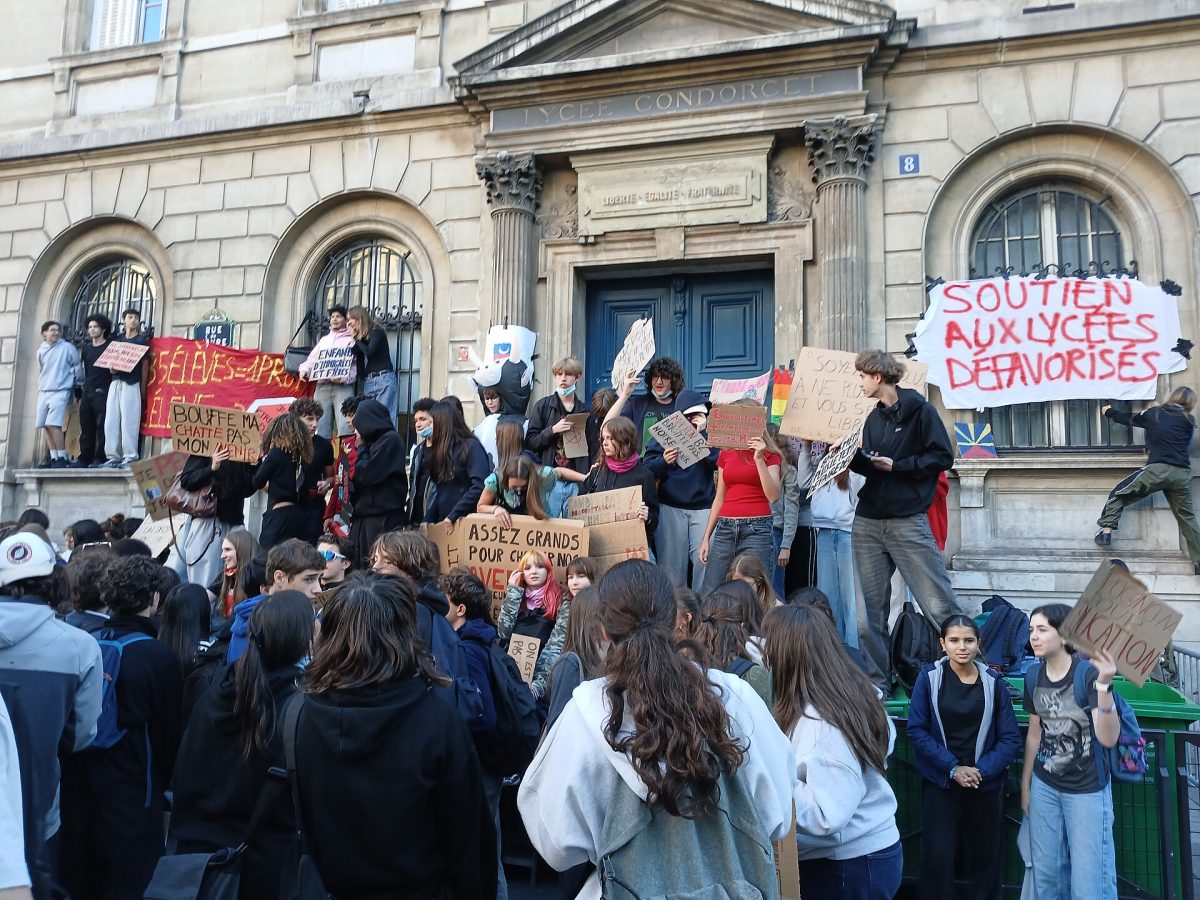
Tens of thousands of high school students in Paris and across France are taking to the streets against severe underfunding for schools, overcrowded classrooms, teacher shortages, and dilapidated school buildings, creating the country’s largest youth movement since the 1990s. What began as a localized protest for basic resources has grown to become a nationwide push to force the French government to take action.
The movement started in mid-September when students began posting videos of broken toilets, moldy ceilings, and classrooms crammed with over 40 students. These videos soon became viral as thousands of students shared their frustration online. Living in a low-income suburb of Paris, 17-year-old Maisa says, “Last year I took the high school French exam without a French teacher, and teachers have a huge impact” (“High school students in Paris’ deprived suburbs spark national protest movement”). Due to staff shortages, for the entire year leading up to the exam, Maisa did not have a proper French teacher to guide her through the material.
According to a BBC article, one student claims that they only have “50 minutes to eat at lunchtime, [yet] there are 2,000 of us that need to get through the canteen”.
“There aren’t even enough chairs. We have to go and find some at the start of every lesson,” he also says.
Inspired by a small student-led blockade in Cretiel in late September, thousands of students across the country have since then joined various protests and marches. By early October, these local complaints had transformed into a nationwide movement. On Tuesday, October 6th, “Authorities estimate hundreds of thousands of protesters, including students, teachers and delegates from trade unions” participating in demonstrations at the Place de La République and Bastille.
As the protests grew over the 3 weeks, police responded with tear gas and batons, leading to some protesters suffering from severe head injuries, broken teeth, and suffocation. One 15-year-old boy lost his left hand after it was blown away by a blast caused by a sting ball grenade (non-lethal stun grenade used by French Riot Squads). He was immediately rushed to a hospital for amputation. Though authorities say he picked up the sting ball, which then exploded in his hand, others have claimed to have seen the device thrown directly at him. Following this incident, Interior Minister Laurent Nunez suspended the use of these stun grenades during student protests. Over the course of three weeks, almost 7,000 students have been arrested, more than 85% being children. 700 police officers have been injured.
Through promises and security, President Macron has tried to alleviate the situation, claiming to bring in a supply of 3,000 teachers in high need areas in the coming days. Additionally, the Ministry of Education has “launched an online portal where students can share their concerns and ideas for improving their education”. Students are still relentless in protests, calling for larger, structural reform—not simple patchworking.
Nevertheless, the government’s actions are hindered by deep debt, which inhibits its ability to fund school repairs. At the same time, with so much fear and chaos surrounding the student protests, investors drive borrowing costs higher, making it even harder for the government to find the money to fix the schools.
Facing a national financial crisis, the French government confronts an immense challenge. Until the situation is resolved, it seems that the students are determined to remain on the streets to fight for their basic educational rights.