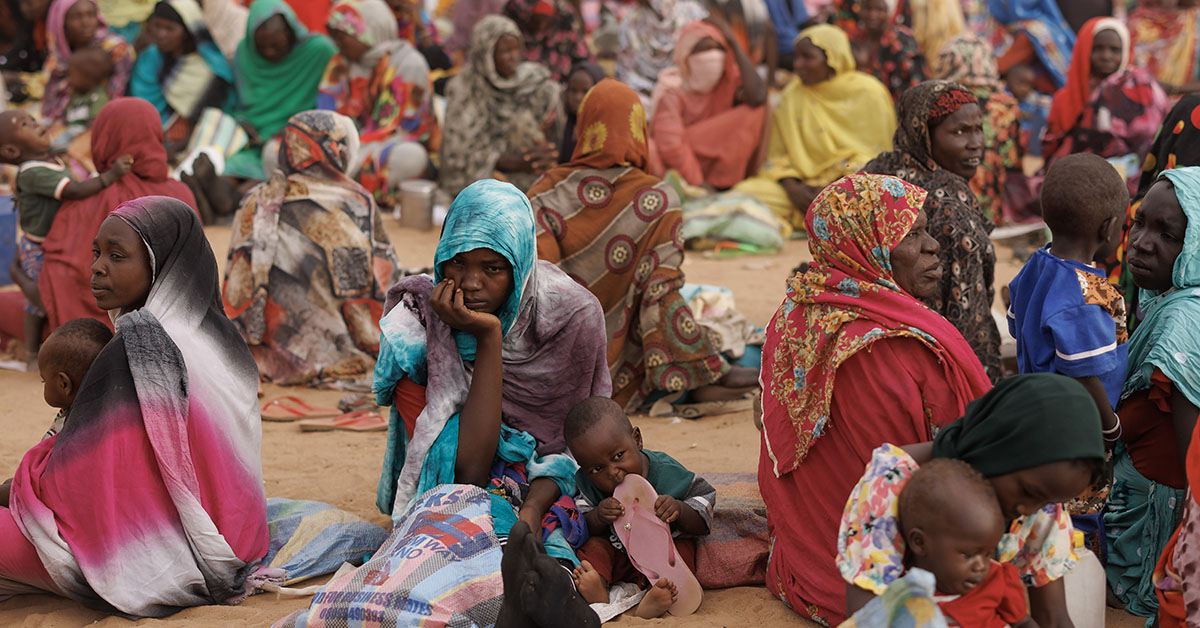
As global fixation shifts from the latest political election to controversial celebrity scandals, Sudan’s crisis remains largely out of view. The social media news cycle moves at lightning speed—a week of outrage, a day of sympathy, and then nothing. Yet behind the scrolling headlines, Sudan has been burning for more than two years. What began as a power struggle between the Sudanese Armed Forces (SAF) and the Rapid Support Forces (RSF) has turned into one of the deadliest and most underreported humanitarian disasters of our time.
The war erupted in April 2023, when tensions between the SAF and the RSF exploded into open combat across Sudan’s capital, Khartoum.
The SAF, Sudan’s national army, led by General Abdel Fattah al-Burhan, represents the country’s traditional military establishment. The RSF, commanded by Mohamed Hamdan Dagalo (better known as Hemedti), evolved from the Janjaweed militias accused of the atrocities during the Darfur conflict. Their conflict for power is rooted in years of instability following the 2019 ousting of longtime ruler Omar al-Bashir. After his fall, a fragile power-sharing government between civilians and the military collapsed in another coup in 2021, led by Burhan and Hemedti. Their alliance quickly broke down over plans to merge the RSF into the regular army, leaving both men unwilling to give up power or influence. When fighting broke down on April 15, 2023, Khartoum became a battlefield—cities reduced to rubble, entire neighbourhoods turned into front lines, and civilians caught in the crossfire.
Today, over two war-torn years later, Sudan faces what the United Nations calls “one of the worst humanitarian crises of the 21st century”. More than 14 million people have been forced out of their homes, and nearly 30 million—two-thirds of the country’s population—now depend on aid to survive. Famine is no longer approaching: it has arrived. Families survive on leaves and animal feed, and children collapse from hunger in camps that are little more than dust and tents. The World Health Organisation (WHO) further reports that dozens of hospitals have been destroyed, medical workers have been abducted, and outbreaks of cholera have been spreading rapidly through displaced communities. Aid agencies have issued urgent calls: the International Organisation for Migration (IOM), UNICEF, and others warn that funding is incredibly low and access is severely restricted, leaving millions without food, medicine, or shelter.
But statistics, however staggering, cannot convey the depth of what Sudan is enduring. This is not just a political crisis—it is an ethnic one. In Darfur, the war has reignited sectarian wounds that never truly healed. During the early 2000s, the region suffered a genocide in which the Janjaweed militias, backed by Omar al-Bashir, carried out mass killings, village burnings, and widespread sexual violence against non-Arab ethnic groups such as the Masalit and Fur. Today, these wounds remain unhealed, as historical grievances, land disputes, and ethnic tensions persist.
Now, with the RSF-SAF conflict, the same groups are again targeted in a campaign of violence and erasure. Entire villages have been burned, families executed, women assaulted, and survivors driven into the desert. “How do people kill each other? How do women get raped and assaulted by their own country?” one survivor questioned in an interview by Al Jazeera. His words hang heavy—a haunting reminder that history is repeating itself, albeit silently.
As the violence worsens, the voices of Sudan’s civilians struggle to be heard. The Office of the United Nations High Commissioner for Human Rights (OHCHR) reported at least 3,384 civilian deaths between January and June 2025, warning that the conflict’s increasing ethnic dimension could “destabilise the entire region.” Yet despite such warnings, coverage of Sudan remains fleeting. Other global issues dominate headlines, receiving far more awareness than Sudan’s crisis. The nation’s suffering is rendered almost invisible—too complex and nuanced, too far away, too uncomfortable. But avoidance, in times like these, is not neutrality. It is complicity. We cannot rebuild Sudan from afar, but we can refuse to look away. To bear witness—truthfully, compassionately, and courageously—is the first act of resistance against erasure.
The people of Sudan do not need pity; they need visibility. They need a world willing to listen beyond the noise to care when caring no longer feels convenient. Because when the world stops paying attention, suffering multiplies in the dark. And when it looks back—even briefly—it has the power to turn silence into remembrance, and remembrance into change.