Who is Sydney Sweeney?
Sydney Bernice Sweeney was born on September 12, 1997, in Spokane, Washington, and moved to Los Angeles at age 13 to pursue acting. Her early roles in Everything Sucks!, The Handmaid’s Tale, and Sharp Objects (all filmed in 2018) got her noticed, but it was Euphoria (2019-2026) and the first season of White Lotus (2021) that brought her wider acclaim, both of which earned her Primetime Emmy nominations. Her film credits include Quentin Tarantino’s Once Upon a Time in Hollywood, and she went on to have leading roles in Reality and Anyone but You in 2023. Alongside her acting, she has built a secondary career as a fashion and beauty spokesperson, modeling for brands including Calvin Klein and MiuMiu. That dual profile means her recent campaigns, which have put her body and appearance at the center of the pitch, have drawn far more scrutiny than a typical celebrity endorsement. Those campaigns range from a genetics pun built around her blonde hair and blue eyes to a near-nude sports ad, setting off public arguments about race, gender, and politics that have reached as far as the White House. This is part of why her advertising choices tend to generate outsized national conversation.
The First Controversy
American Eagle’s “Great Jeans” campaign launched on July 23, 2025. Built around a pun on “jeans” and “genes,” it quickly became one of the most talked-about commercials of the year. In the ad, Sweeney explains how genetic traits like hair color, personality, and eye color are passed from parents to children, then turns to the actual product: denim. Given Sweeney’s blonde hair and blue eyes, some critics argued the campaign was subtly gesturing toward eugenics or white supremacist ideas, while others—including President Donald Trump—praised the ad. The dispute escalated to the point that the White House characterized the backlash as an example of cancel culture, and Vice President JD Vance mocked the critics, suggesting they were treating anyone who found Sweeney attractive as sympathetic to extremism. Trump separately expressed newfound enthusiasm for the ad after learning Sweeney was a registered Republican.
American Eagle responded publicly, insisting the campaign was always meant to be about jeans rather than anything genetic-related. The brand’s stock rose briefly as the ad went viral, but foot traffic to its stores reportedly declined by nearly 9 percent in the weeks that followed. Around the same time, Sweeney’s film Americana underperformed severely at the box office, earning only an estimated $500,000 in its opening weekend.
Sweeney largely avoided commenting during the height of the backlash. Later, she told GQ, the men’s fashion and cultural magazine, in an interview that the controversy hadn’t affected her personally, though she did find it “surreal” that national political figures had weighed in on a jeans commercial. By December 2025, she told People Magazine that her prolonged silence on the issue had deepened the divide rather than easing it, and that she “hoped for more focus on unity going forward”.
The Second Controversy
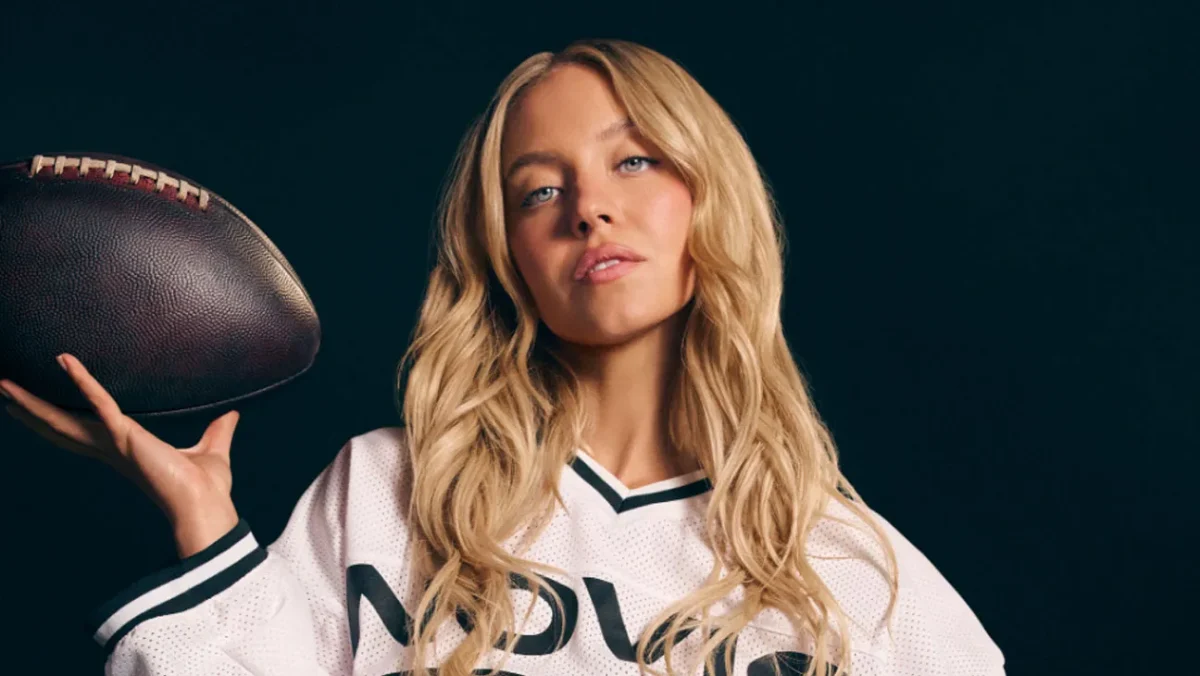
A little over a year after the American Eagle controversy, Sweeney faced fresh criticism over a new partnership with Novig, a sports-trading platform. She is involved as an on-camera spokesperson and also as a strategic partner and equity holder in the company. In the ad, tied to the start of the American football season, Sweeney appears almost entirely nude for much of its runtime, covering herself with sports equipment while describing the platform as a simple way to engage with sports outcomes, without betting on wars, deaths, or politics.
Female athletes were among the most vocal critics. Olympic swimmer Ariarne Titmus strongly condemned the campaign, and British track athlete Amy Hunt warned that prioritizing appearance over athletic ability could discourage young women from pursuing sports. More broadly, critics argued the campaign sexualised women and undermined efforts toward taking female athletes seriously. A Northeastern University professor of communication studies who specializes in sports media argued that the campaign seemed designed to go viral through controversy rather than to say anything meaningful about Novig. He pointed out that most people saw the ad through social media outrage rather than through traditional placements such as billboards or as sponsored search results. He suggested Novig could instead have featured a female athlete in uniform playing her sport, which would have had a far clearer link to a sports-betting product.
Objectification or Agency?
The Novig backlash reopened a long-running feminist debate. Critics argue that context and commercial motives matter, and that women athletes have particular grounds to object when sports-themed marketing turns a conventionally attractive actress into the center of attention. On the other hand, Sweeney’s implicit comparison to athletes who have posed nude raises a fair point. If nudity can express athletic pride, body confidence, or sexual autonomy in other contexts, it becomes harder to treat objectification as simply a woman knowingly presenting herself as desirable.
This tension is unfortunately not new to sports media. A review of 64 studies published between 1994 and 2024 found that female athletes have more often been shown in sexualised poses or minimal clothing than in the act of competing, although more recent research shows a growing focus on the actual athletic performance instead. That documented history is a big part of why many critics viewed the Novig ad as a step backward rather than an isolated incident. Sweeney’s financial stake in Novig also complicates the “personal choice” argument on both sides. As an equity holder rather than just paid talent, she benefits twice from the campaign’s virality, which raises a fair question about how much commercial incentive shapes what gets called empowerment versus what gets called exploitation. Whether that changes the ethics or is simply how modern endorsement deals work now remains a matter of interpretation.
A similar complication runs through the American Eagle case. Because that backlash was split so sharply along political lines, progressive commentators and many social media users condemned the ad as racially coded, while Republican figures, including Trump, Vance, and Senator Ted Cruz, defended it and framed the criticism as “woke” overreach. That makes it harder to separate genuine concern about racially coded advertising from a wider political dispute that used the ad as a proxy battleground. But both things can be true at once: the eugenics-adjacent reading is a legitimate critical interpretation, even if the brand didn’t intend it, and the intense political amplification likely shaped how generously each side engaged with the other’s argument.
Conclusion
Both controversies return to the same unresolved question: when a woman chooses to present her body, whether sexually or through language about genetics and desirability, is that a genuine choice, or does calling it a “choice” obscure the commercial and cultural pressures behind it? Sydney Sweeney, her critics, her defenders, and the companies involved have all taken positions that make sense on their own terms, even when they directly clash with one another. With a platform as large as hers, these debates affect how the public thinks about race, gender, and the way women’s bodies are marketed, which helps explain why the scrutiny, coming from multiple directions, has been so intense.