Today, artificial intelligence (AI) is becoming deeply embedded in our world: school life has shifted for both students and teachers, thousands of employees at corporations have been replaced by large-language-models, and AI start-ups have boomed across the world, engendering what many consider to be an AI bubble. While AI has become an essential to many people’s lives, often employed as an efficient tool to streamline basic tasks, its effects in the creative world have been notably controversial. As AI enters creative fields, we must be prudent about its artistic use, as it relies on replicating existing works undermines what we value as human creativity and threatens artists’ livelihoods.
The growing presence of AI image generation in the art world gained significant attention in 2021 when OpenAI, a major AI company, announced DALL-E: a program designed to create images from text prompts. Although it was not released to the public at first, it sparked widespread attention to text-to-image generation, paving the way for similar platforms like “Midjourney,” which has become one of the most widely used AI-based image generators to date.
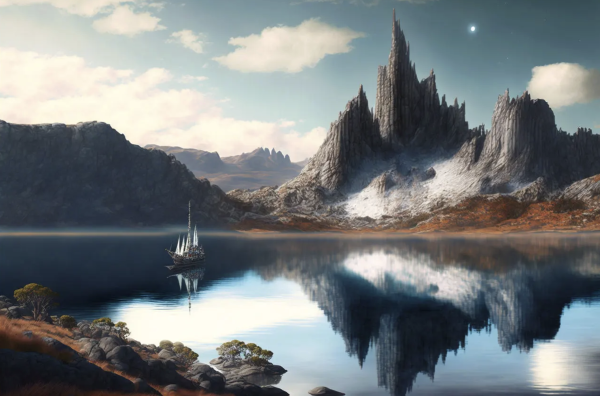
A year after OpenAI announced DALL-E, Colorado artist Jason M Allen entered Colorado’s State Fair’s annual art competition. His submission, titled “Théâtre D’opéra Spatial“ (which translates to Space Opera Theater), was created using Midjourney. Allen won a blue ribbon prize in the contest for digital artistry, despite being unapologetically explicit about the origins of his work: “I won, and I didn’t break any rules,” he asserted when questioned about the integrity of his submission.
Allen’s situation spurred global discussion on AI’s pervasion into art spaces. Artists who had spent years perfecting their skills now found themselves in competition with individuals who could produce polished works with just an AI prompt. This shift has since left artists frustrated and overshadowed, as many of them see their dedication to this craft and personal creativity reduced to something that can be easily replicated in seconds through programs like Midjourney.
However, supporters of AI art argue that these programs can expand creative possibilities for both artists and non-artists. For example, in 2019, German artist Mario Klingemann sold an AI-generated morphing portrait for £30,000—the equivalent of $50,000. What set Klingemann’s art apart is the type of AI program he used. His work required him to create and build a custom dataset, an intensive process that requires technical skill beyond writing a prompt. Such an example, supporters argue, proves that AI art doesn’t necessarily have to be devoid of the artistic process. Still, many in the art space remain steadfast in the opinion that the drawbacks of generative AI far outweigh the benefits, especially when one considers how it diminishes originality and reshapes what we define as art.
This viewpoint stems from the way AI programs operate. AI, itself, cannot create anything original; rather, it remixes patterns learned from massive training datasets. AI models study and imitate artworks from their training datasets, which are often included without the original artists’ consent. Over time, models analyze and distinguish different objects by identifying quantifiable metrics or features such as color, roundness, and shininess to help separate these images into a mathematical, high-dimensional space called the latent space of deep learning. And when users enter a text prompt, the model locates a point within this latent space and uses a generative technique known as diffusion to transform random noise into a detailed image. Due to the randomness in the process, identical prompts will never produce an image in the same way.
However, this randomness should not be mistaken for originality. AI can only imitate the tireless creative choices and precise intention that a human artist puts into their artwork. Again, artificial models do not understand what they create; they merely structure random fragments of pre-existing human art. They lack memories or experiences that shape individual style, altogether resulting in the elimination of individuality, vision, and emotional depth from the artistic process.
Furthermore, AI programs are also becoming a significant threat to artists’ livelihoods and opportunities. The use of AI-generated images in advertisements has become increasingly prevalent, a trend that disproportionately affects freelancers and artists who rely on commissions for their income. While it is understandable that smaller companies with limited budgets may turn to AI, even major, established companies have opted to use AI for their advertising. For example, both Coca-Cola’s 2024 Christmas advertisement and Skechers’ “the Uno Skechers” billboard advertisement employed AI in their creation.
This shift in the creative industry puts many independent artists’ careers at risk. A recent report, led by Queen Mary University of London, surveyed 335 freelance creative professionals and found that 73% of respondents believe generative AI is changing the quality of work in the creative industries, while 68% feel that their job security has been reduced due to the rise of these new technologies. Not only do they fear for their careers, but they have also expressed concern about how their work is being perceived and reimbursed. 61% say that the value others place on their work has decreased. Lastly, 55% also report a decline in financial compensation. These numbers are only expected to increase as generative AI continues to gain dominance in creative fields.
Ultimately, the use of Generative AI has become a crucial concern in the art world. While there are certain ways to utilize AI creatively during the artistic process, the severe ramifications of this new technological innovation cannot be disregarded. What we define as art and creativity has become increasingly unclear, and artists’ livelihoods are at stake as job opportunities diminish due to increased use of AI by corporations. Without proper regulations and recognition of human artistry, the future of the art industry and its diversity of voices face serious challenges.