
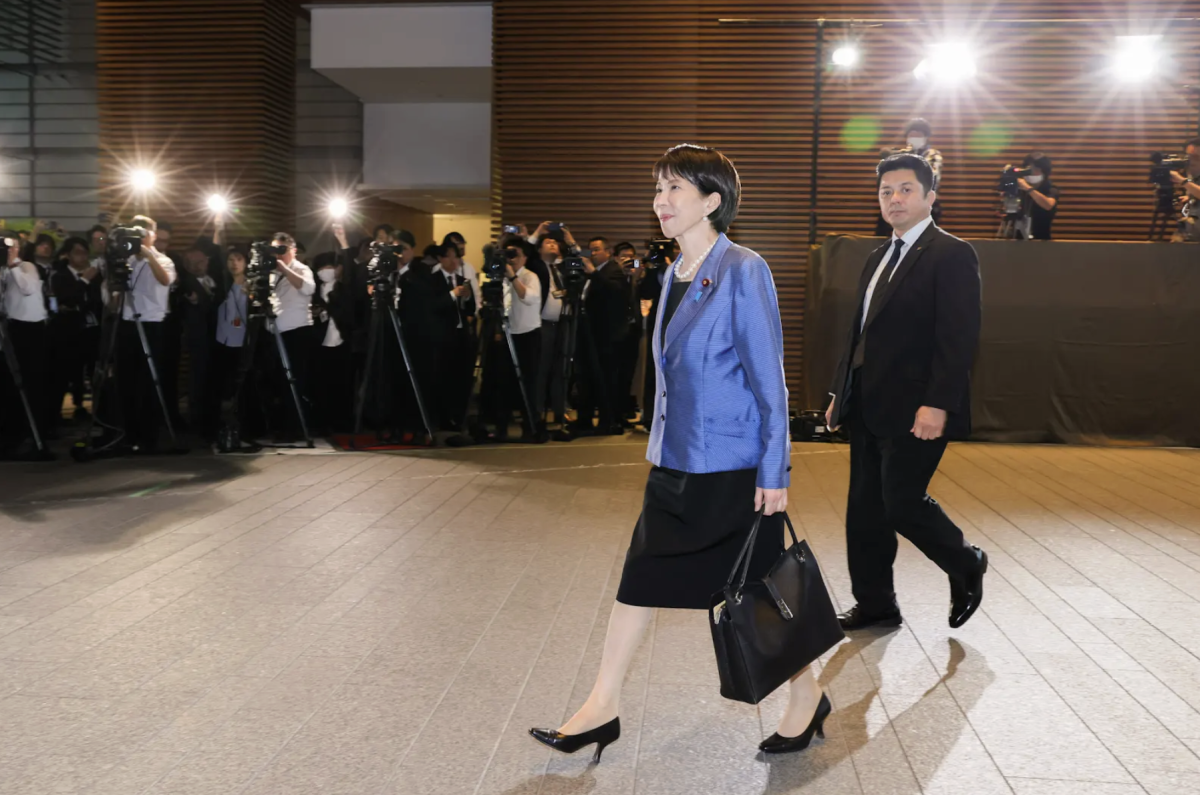
At an extraordinary Diet session held on October 21, Sanae Takaichi was elected as Japan’s first female prime minister, marking a historic milestone in the nation’s political history. Amid efforts to recover from declining support, the ruling Liberal Democratic Party (LDP) faced the challenge of winning back its traditional conservative base, making Takaichi—a staunch conservative—an especially strong candidate.
Following former Prime Minister Ishiba’s September 2025 resignation, the LDP was forced to select a new leader. Its leadership election, held under the slogan #ChangeLDP, featured five candidates in a closely contested race voted in by both rank-and-file party members and party lawmakers. Takaichi, who received strong support from the party’s member base, maintained a lead from the first round, emerging victorious in the runoff against the moderate Shinjiro Koizumi, who lost despite support from various LDP lawmakers.
In the past, being elected as president of the LDP—Japan’s largest political party—was a near guarantee that a candidate would become prime minister thanks to the party’s longstanding majority coalition with the centrist Komeito party. However, after Takaichi’s victory in the LDP leadership election, Komeito withdrew from the coalition, citing concerns about the party’s misappropriation of funds and Takaichi’s conservatism, including her “revisionist” views on Japan’s actions during World War II; this left it uncertain whether or not the Upper House of Japan’s parliament would vote to officially elect her. As a result, the LDP was forced to form a new coalition with the Japan Innovation Party (Ishin), allowing the party to maintain its majority government. Ultimately, this enabled Takaichi to officially assume the role of prime minister after the Upper House voted to appoint her as Japan’s new head of government.
Born in Nara Prefecture to a middle-class family, the 63-year-old Takaichi has had a long and varied political journey. She studied Business Administration at Kobe University, where she also played drums in a heavy metal band. After graduating, she studied at the Matsushita Institute of Government and Management and was sponsored to work under U.S. Congresswoman Patricia Schroeder. Takaichi was first elected to Japan’s Lower House of Parliament in 1993 and has since held several cabinet positions, including Minister for Internal Affairs and Communications and Minister for Economic Security, as a member of the LDP and adherent of former Prime Minister Shinzo Abe’s conservative philosophy.
Her statement upon taking the Prime Minister’s office — “I will work, work, work, work, and work” — generated significant media coverage and won Japan’s 2025 Buzzword of the Year Award. However, families who have lost loved ones to ‘karoshi’—the Japanese term for death by overwork—criticized her for her lack of consideration for work-life balance, and some politicians raised concerns that her leadership could steer Japan further to the political right.
In her first weeks as Prime Minister, Takaichi made foreign policy strides, attending the ASEAN summit in Malaysia, meeting with U.S. President Donald Trump during his state visit to Japan, and joining the APEC leaders’ summit in South Korea. In late November, though, Prime Minister Takaichi’s remarks about Taiwan drew strong backlash from the Chinese government, leading to a serious deterioration in Japan–China relations. There is still no clear diplomatic path to resolving this breakdown.
Domestically, Takaichi has already utilized her position to push for stricter enforcement of laws on foreign nationals in Japan, as promised during her campaign. She intends to limit the number of yearly visa admissions to Japan and investigate foreign land ownership amid concerns of increased foreign real-estate investment across the country. The new Prime Minister is also considering constraining the naturalization process for foreign nationals in Japan by extending the residency requirement to acquire Japanese nationality. Still, Takaichi has explicitly acknowledged Japan’s demographic ticking time bomb, seemingly aware that immigration may be crucial to alleviating Japan’s aging population.
According to the World Economic Forum’s Global Gender Gap Report 2025, Japan ranks 118th out of 148 countries—the lowest among G7 nations. Although many challenges remain in Takaichi’s path to a successful term, including improving Japan-China relations, the country’s first female prime minister is still widely recognized as a symbolic step forward in Japan’s political development. As Takaichi continues to bring her conservative vision to reality, only time will tell if she will restore the relative political stability Japan enjoyed under former Prime Minister Shinzo Abe.







Chuy • Dec 3, 2025 at 1:20 AM
Very good article !