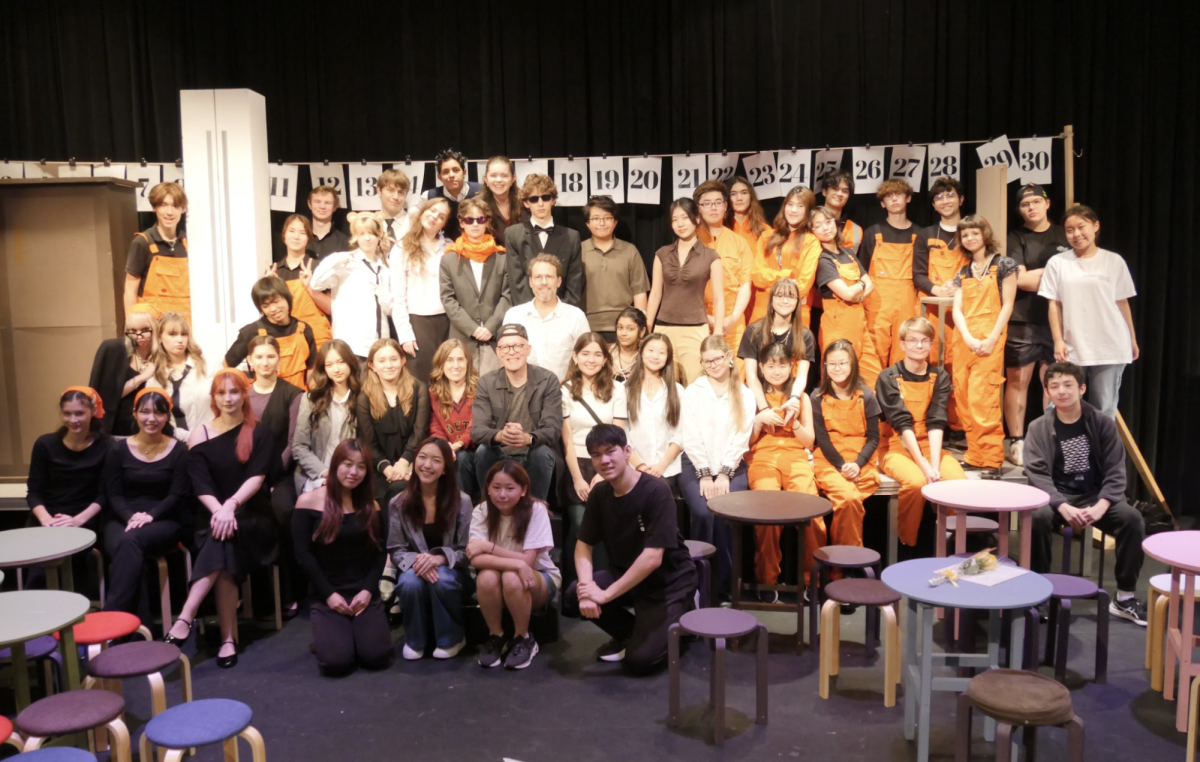
When I arrived at the Black Box theatre on Friday evening, I expected to sit comfortably at the back of the makeshift bleachers and enjoy a classic ASIJ Fall Play. However, I was met with something entirely different from what I had imagined. Here is my account of my experience watching this year’s show.
Entering the venue, a waiter handed me a menu and led me to a restaurant-style table, where the menu included a list of short play titles numbered 1 to 30. The audience was asked to call out the numbers of the plays they wanted to see, and the actors would act them out. The goal was to finish all plays in under 60 minutes, which unfortunately was not attained on Friday (although they managed to go through all 30 plays the night before). I believe the cast not finishing all 30 plays gave the performance a nice charm, serving as a reminder that live performance is unpredictable and alive in the moment.
What most surprised me was the way the stage was set; the audience, with chairs and tables arranged in a typical restaurant fashion, was placed in the middle of the Black Box, while the action unfolded all around us on four distinct stages, each unique from the others. As a frequent watcher of plays, I have never seen a setup like this in any play I’ve attended, and I was happy to see the Black Box being adapted to its fullest potential. The proscenium-style plays of past years have underutilized the Black Box, which is meant to be a flexible and experimental performance space.
Another notable departure from traditional ASIJ theater was its frequent use of fourth wall breaks; from the moment I stepped into the Black Box to the moment I stepped out, interactions between the audience and actors occurred constantly. At times, even some of the audience members, including myself, were called up onstage and participated in the show, playing a part as if we were members of the cast. In particular, “Blind Date,” in which an audience member simulated a first date with the actor, was very comical.
Even more interestingly, this year’s Fall Play showcased how far the cast pushed its satire; many scenes contained dark humor with not-so-subtle political undertones, which contrasts with previous family-friendly plays under earlier ASIJ direction. This shift suggests ASIJ actors are increasingly willing to push boundaries and challenge existing norms.
To learn more about the play’s development, I interviewed Meredith Michels, a member of the ASIJ cast. Meredith also wrote an article on the avoidance of political expression in our school, titled “The Quiet Crisis: The Conversations We Avoid,” so her insight was valuable. When asked what she thought of the political commentary in the play, here’s what she had to say: “I think theater is such a good way to express political commentary because it’s not pushing an agenda down someone’s throat, it’s just showing what the world is like today in a more understandable, emotional way that people can really connect with, and I think that’s powerful.”
In particular, Meredith mentioned the scene “Memorial Day”, where the actors rushed onstage shouting different agendas on gun violence until they eventually got shot one by one, and called it “powerful and unapologetic.” As an audience member, I felt the same way—the scene was impossible to look away from.
Furthermore, regarding the specific scene “How to War”, Meredith claims, “It’s just a reflection of our society, but painted in such a clear way that it makes people reflect on what we’re actually doing in the world.”
Overall, “Too Much Light Makes the Baby Go Blind” was a phenomenal show. The emotional rollercoaster of going through quick-paced scenes was exhilarating and left the audience wanting more. The political commentary skillfully integrated into the show added to the air of unpredictability and made us ponder the messages the acting team, director, and crew wanted to convey. And as is the goal of any theater production, we left with the show still lingering in our minds to this day.
The following section, written by Sophie Lee, includes interviews with additional cast members.
Cast Perspectives on Too Much Light Makes the Baby Go Blind
Eccentric. Human. Eye-opening. Unexpected. Inspired. Truth. These are some of the words this year’s Fall Play cast used to describe Too Much Light Makes the Baby Go Blind (TMLMTBGB).
Imagine a play about a play about a play, where actors act as themselves acting. Now, multiply that by 30 and add a one-hour limit. If you can wrap your head around that, you’ll start to grasp the essence of this year’s Fall Play.
To gain deeper insight into the actors’ thoughts on the Fall Play, I interviewed five cast members about their experiences jumping into TMLMTBGB: Kostya Menshikov (G11), Hiyori Izushima (G11), Paige Statton (G10), Tim Hageman (G12), and Julia Kaps (G9).
When asked which short play or moment in the show challenged or surprised them the most, Kostya explained that “10 Years and Six Months” (#13)–a silent play–forced him to rely on his facial expressions and intentional pop-and-freeze. Hiyori shared that during “A Monologue” (#24), no lines were designated, requiring the “invisible string between cast members” to create an understanding built on trust and faith that all the lines would be recited. For Paige, “Herr Director” (#26) was the most challenging because of its many lines, but it also gave her the most room for her imagination to unfold. Tim, for whom TMLMTBGB was the first production, found “Title” (#1) difficult, as it required him to make intonation and movement intentional. For Julia, the audience held the biggest surprise, as she could not anticipate their reactions.
The next question we posed was how TMLMTBGB influenced the actors’ perceptions of theater. Kostya had already been in similar productions and understood that theater should be flexible, but realized that acting could be even more fun than he had thought before, after TMLMTBGB. Hiyori used to think theater was a type of service–the performer provided entertainment, which the audience consumed. However, she now understands that the energy the cast sets should boomerang back to them from audience reactions: “Theater is a game of reciprocity.” Paige shared that although she was skeptical when starting out at auditions, she now believes that “this beautiful piece of theater that was born from the chaos and unconventional methodology is something I wouldn’t trade for the world.” Tim, who had expected to play a villain role for his first production, realized that theater stretches beyond the typical protagonist-antagonist plot. For Julia, TMLMTBGB made her feel like she was “learning the concept of performing onstage for the first time again” due to the unique nature of the play. She gained a broader perspective about the dynamics between actors and the beautiful chaos that symbolized their truths.
Finally, onto their favorite part of the show. Kostya said that he enjoyed moments when the entire audience would burst out in laughter, the sounds of their joy vibrating through the Black Box. For Hiyori, pre-show–the short, ten-minute period before the onstage performance began, when the cast wandered and the crew’s demolition of the set–was her favorite part. Paige shared that “A Monologue” was her favorite play in the show, as the complications and experimentation created something “so profoundly beautiful that will never be forgotten.” Julia enjoyed Herr Director and A Pair of Socks the most, as they never failed to get a loud laugh out of her.
From social and political commentary to insights into the unannounced processes of performance, Too Much Light Makes the Baby Go Blind transformed and challenged preconceived notions of theater; it was unconventional and utterly vivacious. To put it simply, a glimpse away from our daily lives. The Black Box became a world of five stages with names ranging from René to Edamame, uncovering abstruse truths through silent comedies, romances, and lively audience interaction. And yes, there really was a Domino’s pizza delivery.
Curtain!